1 January 2026
2025 wasn’t a bad year for electrical installations.
It was… educational.
Hundreds of upgrades, dozens of new homes, expanding PV systems, garages turned into workshops, gardens powered “just for now.” And still the same mistakes, repeated like a refrain: “this will be enough,” “why leave spare capacity,” “we’ll do it later.”
The problem is that in electrical installations, “later” often turns out to be too expensive — or too dangerous.
That’s why, entering 2026, it’s worth saying this clearly:
⇒ not everything needs to be done again — but some mistakes must not be repeated.
This article is a concrete list of things that caused problems in 2025 — and simple ways to avoid them in 2026. No scare tactics. No moralizing. Just a focus on safety, comfort, and long-term peace of mind.
Why do we keep making the same mistakes?
Because an electrical installation:
-
is invisible once the work is finished,
-
“works,” so it seems fine,
-
is often built under time and budget pressure.
And the truth is this: the most expensive mistakes only show up later — when something needs to be added, modified, or repaired.
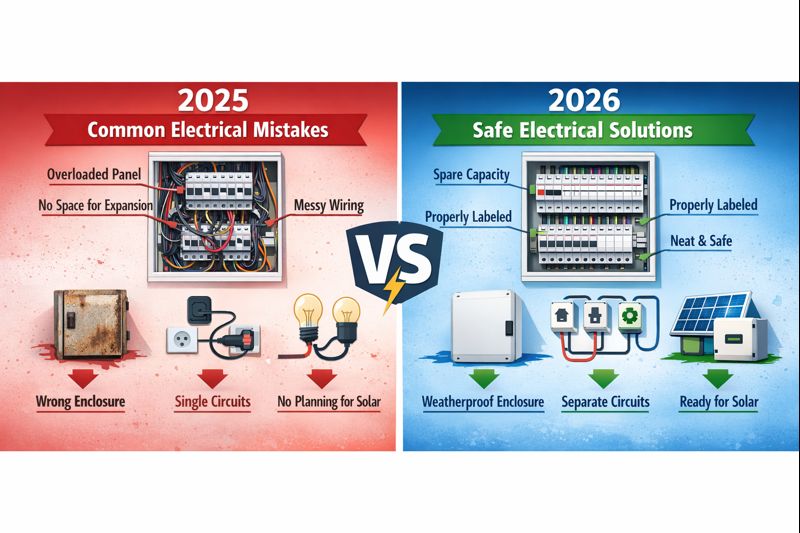
Mistake #1: A distribution board “just enough”
What happened in 2025?
A classic scenario: the distribution board sized exactly for today’s needs.
No reserve. No room for the future.
The result?
-
no space for an additional circuit,
-
no room for PV, a heat pump, or a wallbox,
-
temporary, makeshift additions,
-
replacing the entire enclosure after just 2–3 years.
How to avoid this in 2026?
The rule is simple:
if you need 12 modules today — plan for 18 or 24.
A distribution board with spare capacity:
-
gives flexibility,
-
saves money in the long run,
-
keeps the installation clean and readable.
System solutions work particularly well here — for example Hager distribution boards, available at Preis-Zone — both surface-mounted and flush-mounted, with logical layouts and room for expansion.
Mistake #2: No sensible circuit separation
What was the issue?
In 2025, installations still appeared where:
-
the kitchen was on a single circuit,
-
sockets and lighting shared the same circuit,
-
garage, garden, and workshop were all combined.
It works… until the first overload.
How to do it better?
Well-designed circuits mean:
-
safety,
-
convenience,
-
easier fault diagnosis.
In 2026, the standard should be:
-
separate circuits for the kitchen,
-
separate circuits for bathrooms,
-
separate circuits for garage and workshop,
-
separate circuits for outdoor points (garden, terrace).
And once again, this leads back to point one: a properly sized distribution board with spare space.
Mistake #3: The wrong enclosure in the wrong place
What went wrong?
In 2025, installers still used:
-
standard enclosures in damp rooms,
-
non-sealed boxes in garages,
-
distribution boards without adequate IP rating outdoors.
The result?
-
corrosion,
-
issues with protective devices,
-
shortened system lifespan.
How to avoid it?
Choose the enclosure based on the environment, not the price.
-
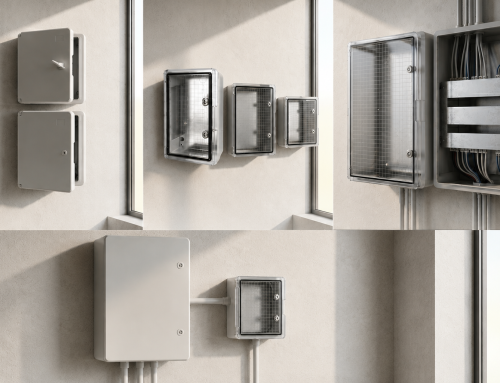
house / apartment → aesthetic flush-mounted distribution boards,
-
garage / workshop → solid surface-mounted enclosures,
-
garden / outdoors → enclosures with higher IP ratings (e.g. IP65).
This isn’t overkill — it’s real protection for the installation.
Mistake #4: “PV someday” — no preparation
A 2025 classic
“Solar panels? Maybe in two years.”
And later:
-
no space in the distribution board,
-
no logical circuit layout,
-
modifications that cost more than planning ahead would have.
2026 thinking
Even if the PV system isn’t installed today:
-
leave space in the distribution board,
-
plan for future protective devices,
-
design a logical layout from the start.
That’s the difference between an installation done “somehow” and one that’s future-ready.
Mistake #5: Chaos instead of clarity
What did we see?
-
no circuit labeling,
-
no logic in protective device placement,
-
no service space.
Why is this a problem?
Because during a failure:
-
you lose time,
-
you risk mistakes,
-
you make work harder for the electrician — or yourself.
The solution?
A clear distribution board means:
-
a logical layout,
-
labeled circuits,
-
spare space,
-
order.
That’s user comfort, not aesthetic obsession.
Benefits for the user (what you really gain)
A well-designed electrical installation offers:
-
household safety,
-
peace of mind for years,
-
easy expansion,
-
time and cost savings,
-
reliable operation — even as the system grows.
It’s an investment that works quietly, every day.
Recommended solutions available from Doktorvolt®
In the Doktorvolt® range you’ll find:
-
surface-mounted and flush-mounted distribution boards,
-
enclosures with higher IP ratings for garages and gardens,
-
Hager system solutions that are:
-
modular,
-
aesthetic,
-
ready for expansion,
-
proven in real installations.
-
These are solutions that don’t limit you — they give you room to grow.
Questions worth answering
Do I really need spare capacity in the distribution board?
Yes. It’s one of the cheapest elements of an installation — and one of the most important.
Does aesthetics matter?
Yes — especially in homes and apartments. But never at the expense of functionality.
Is it worth planning for PV if I’m not sure I’ll install it?
Absolutely. Preparation costs very little; retrofitting costs a lot.
Is every distribution board suitable for a garage?
No. Garages and workshops require more robust enclosures and higher IP ratings.
Can I expand an old installation?
Sometimes yes — but often it’s safer and cheaper to replace key components.
Summary: 2026 is the right time to do it wisely
2025 showed one thing clearly:
installations built “just for now” age quickly.
2026 is the right moment to:
-
plan with spare capacity,
-
think ahead,
-
choose solutions that don’t restrict future growth.
A properly chosen distribution board isn’t a detail.
It’s the foundation of safety, comfort, and peace of mind for years to come.
If you have doubts — it’s better to ask today than to fix things tomorrow.